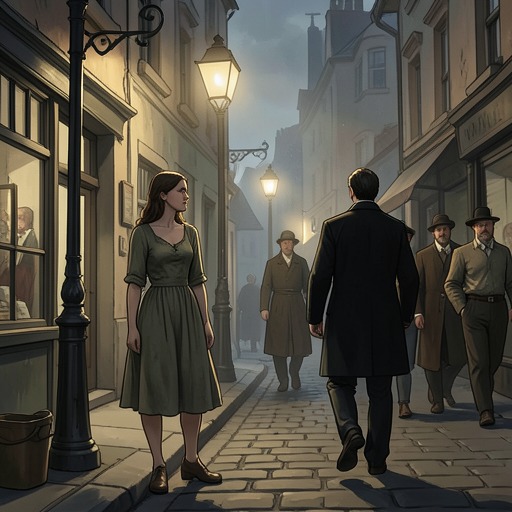
Martin’s reunion with Lizzie at Shell Mound Park
Martin EdenMartin’s reunion with Lizzie Connolly at Shell Mound Park brings him briefly back among the working people of his youth, but it also exposes how far he has changed. Their renewed closeness raises the possibility of a shared future; Martin’s refusal of marriage, followed by a tender parting, makes the picnic a test of whether he can recover his former life after his ambitions and disappointments have remade him.
Return to the Working-Class Picnic
Martin goes to Shell Mound Park after learning that a Bricklayers’ Picnic is taking place there. The gathering recalls the working-class picnics he attended earlier in life, and the people around him seem at first to restore a lost sense of belonging. When an old acquaintance recognizes him, Martin joins the familiar group for drinks. He thinks of these people as his own kind: he was born and lived among them, and his return feels like a welcome homecoming after a period of wandering.
That warmth is genuine, but it does not erase the changes he has undergone. The beer no longer tastes as it once did, and Martin wonders whether books have spoiled him for the companionship he once knew. He resolves not to let that distance take hold. Dancing and joking with the old crowd, he feels human again; because he has money in his pocket, he spends freely, much as he used to after returning from a voyage with pay. The crowd likes him for himself, not for a reputation built on published books, since none of his books has yet appeared.
The scene arrives while Martin is imagining a different escape from his recent disillusionment. He has pictured making money in California and then settling in the Marquesas, with a schooner and a home in the valley by the bay. At the picnic, however, the attraction of familiar company and the possibility of renewed intimacy with Lizzie interrupt that plan. The gathering offers a return, but the changes in his tastes and ambitions make it an unstable one.
Reunion and the Altercation
Martin first sees Lizzie on the dance floor, paired with a young workingman. Later, he finds her sitting by a refreshment table and leads her away from the music so they can talk. He recognizes that she is no longer the young girl he once knew. In his view, her beauty has matured, while her former defiance and fire have become more controlled. He senses that she is still attached to him and that she might follow him wherever he went.
That impression is interrupted when the young workingman strikes at Martin. Martin reacts and knocks the man down; friends hurry over and restrain him as he protests that Lizzie had been waiting for him to return. The altercation makes the man’s claim of attachment plain, but it does not alter Martin and Lizzie’s conversation. Martin asks who the man is and what has happened. The excitement of fighting, once an absorbing part of his life, quickly fades; he is now too self-analytical to settle easily into the uncomplicated existence he once knew.
Lizzie tells him that the matter belongs to the past. Martin does not pursue it. Instead, they continue their day together: he orders lunch and wine, dances with her, and later rests with his head in her lap while she strokes his hair. Her tenderness makes her affection unmistakable. She tells him that she has kept straight through the years, a disclosure Martin recognizes as true.
The Future Martin Refuses
Lizzie’s devotion confronts Martin with a choice he can imagine but cannot accept. He believes he could make her happy by marrying her and taking her to the Marquesas, where he had envisioned a home in the valley. For a moment, this possibility competes with his plans to leave the books and the world that disappointed him behind. Yet he concludes that the person he is now cannot return to the former life of license and easy living. His fidelity to his ideal of Love, and the change in his own character, outweigh the desire to offer Lizzie the happiness he thinks she deserves.
Martin tells her lightly that he is not a marrying man. When her response makes clear how deeply she cares for him, he answers with warmth but not with passion. He praises her as a good and generous woman, says that he admires and respects her, and insists on being honest: he will neither marry nor enter a relationship without marriage. He regrets having come to the picnic and encountered her in this way, but he does not pretend that his feelings are indifference. He also offers to make her life easier, saying that he expects to have money soon. The offer is distinct from a proposal; he wants to help her, while refusing the future she would accept with him.
His decision changes the imagined future he had carried into the scene. He abandons the vision of the Marquesas valley, its grass-walled home, and the white schooner. He could instead go to sea again, as he has before, on a ship bound anywhere. The contrast clarifies that his refusal is not simply a preference between Lizzie and a settled home: he is unable to commit to either the domestic future she desires or the tropical retreat he had planned for himself.
The Parting and Its Significance
As Martin is about to say good night, Lizzie leans toward him without demanding anything. He is touched, embraces and kisses her, and understands the kiss as genuine. Lizzie says she could die for him, then breaks away and runs up the steps. Her abrupt departure leaves Martin alone with the recognition that he has hurt someone whose devotion he believes to be sincere.
Afterward, Martin reproaches himself for not being able to marry her, and calls himself a poor Nietzschean rather than a brute. The self-accusation captures the conflict more sharply than a simple account of rejection would: he sees Lizzie’s generosity, wants to make her happy, and still cannot choose the life that would answer her love. The reunion therefore does not restore his earlier working-class self or give him a replacement for his disillusionment. It brings him close to companionship and a possible home, then reveals that he can neither accept Lizzie’s offer of love nor resume the life he once shared with people like her.